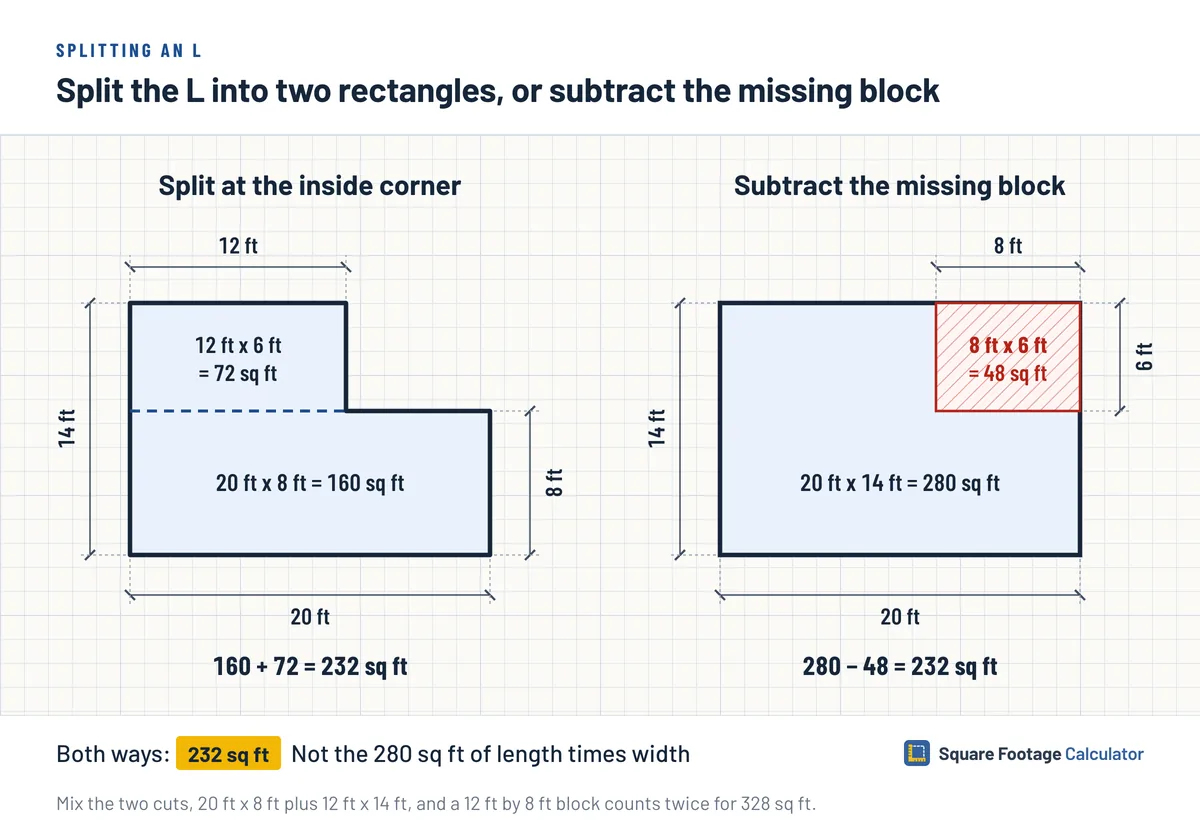
To get the square footage of irregular shape floors, cut the outline into rectangles, triangles and trapezoids, work out each piece in feet, and add them. You can also take the big rectangle around the room and subtract the part that is missing. The L-shaped room below comes to 232 sq ft by splitting, by subtracting and by corner points, so the three methods agree.
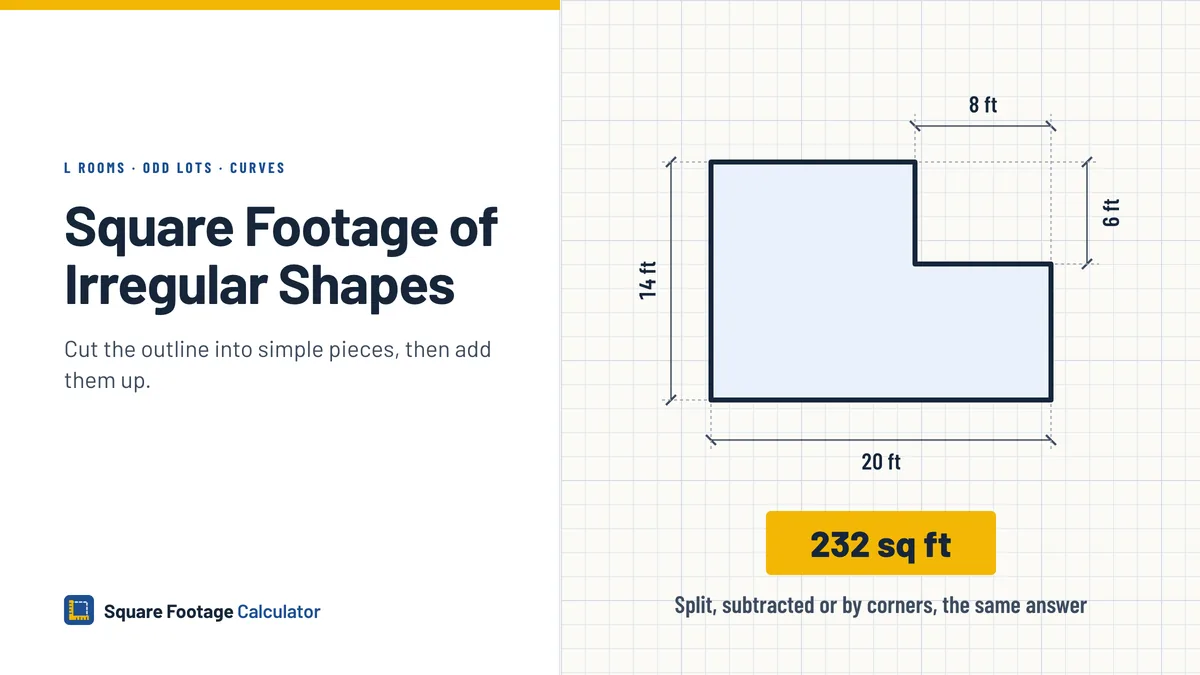
Table of Contents
- Which method fits your outline
- Find irregular shape square footage by splitting an L
- T-shaped and U-shaped room square footage
- Square footage with 4 unequal sides
- Shoelace formula for corner coordinates
- Bay windows and clipped corners
- Measuring a curved edge with offsets
- Regular hexagons, octagons and pentagons
- Check the total a second way
- FAQ
- Conclusion
Which method fits your outline
To calculate the square feet of an odd shape, find your outline in the left column below. Start with the first row if all your walls meet at square corners.
| Your outline | Method | What to measure |
|---|---|---|
| L, T or U room | Split into rectangles, or subtract the missing block | Every wall |
| Four sides, no square corners | Two triangles along a diagonal | Four sides and one diagonal |
| Lot or room with many corners | Corner points (shoelace) | An x and a y for each corner |
| Angled bay or clipped corner | Trapezoid, or rectangle minus a triangle | Bay: both parallel sides, depth square to the wall. Corner: the two short sides |
| Curved wall or patio edge | Offsets from a straight baseline | Offsets at even spacing |
| Regular hexagon, octagon, pentagon | Factor times side squared | One side |
Find irregular shape square footage by splitting an L
Before you calculate square footage for any irregular shape, letter each wall on a sketch, because a lettered wall is hard to skip.
- Draw the room roughly to shape and give each wall a letter.
- Tape each wall to the nearest inch and turn the inches into feet before you multiply. The square footage calculator takes feet and inches as you type them and keeps a running total of the pieces.
- From every inside corner, rule a line straight across so the pieces meet edge to edge and never overlap.
- Multiply length by width for each piece and add, or subtract the empty corner from the rectangle that wraps the room.
Take the L: 20 ft along the long wall, 14 ft deep, with an 8 ft by 6 ft block missing at one end. Split it and you get 20 ft x 8 ft = 160 sq ft, plus 12 ft x 6 ft = 72 sq ft, for 232 sq ft. Subtract instead. The full 20 ft x 14 ft is 280 sq ft, and taking away the 48 sq ft notch leaves 232 sq ft again. Cut it the other way and you get 12 ft x 14 ft plus 8 ft x 8 ft, or 232 sq ft once more. Mix the two cuts, as 20 ft x 8 ft plus 12 ft x 14 ft, and you get 328 sq ft. A 12 ft by 8 ft block gets counted twice in that total.
Finding the square footage of irregular shapes with ten walls is the same job with more pieces. A whole-house total is built one level at a time, so measuring each floor of a house comes first and the odd corners slot in after.
T-shaped and U-shaped room square footage
Choose the split that leaves fewer pieces. When the gap in the outline is one clean rectangle, subtracting it is usually faster.
The table works both rooms each way.
| Room | Add the pieces | Subtract from the outline | Total |
|---|---|---|---|
| T: 24 ft x 10 ft crossbar, 10 ft x 12 ft stem | 240 sq ft + 120 sq ft | 528 sq ft minus two 7 ft x 12 ft corners | 360 sq ft |
| U: 26 ft x 18 ft, 10 ft x 11 ft notch | Two 8 ft x 18 ft legs + a 10 ft x 7 ft strip | 468 sq ft minus 110 sq ft | 358 sq ft |
In the U, subtracting is one step. Adding takes three pieces, and each one is a fresh chance to misread the tape.
Square footage with 4 unequal sides
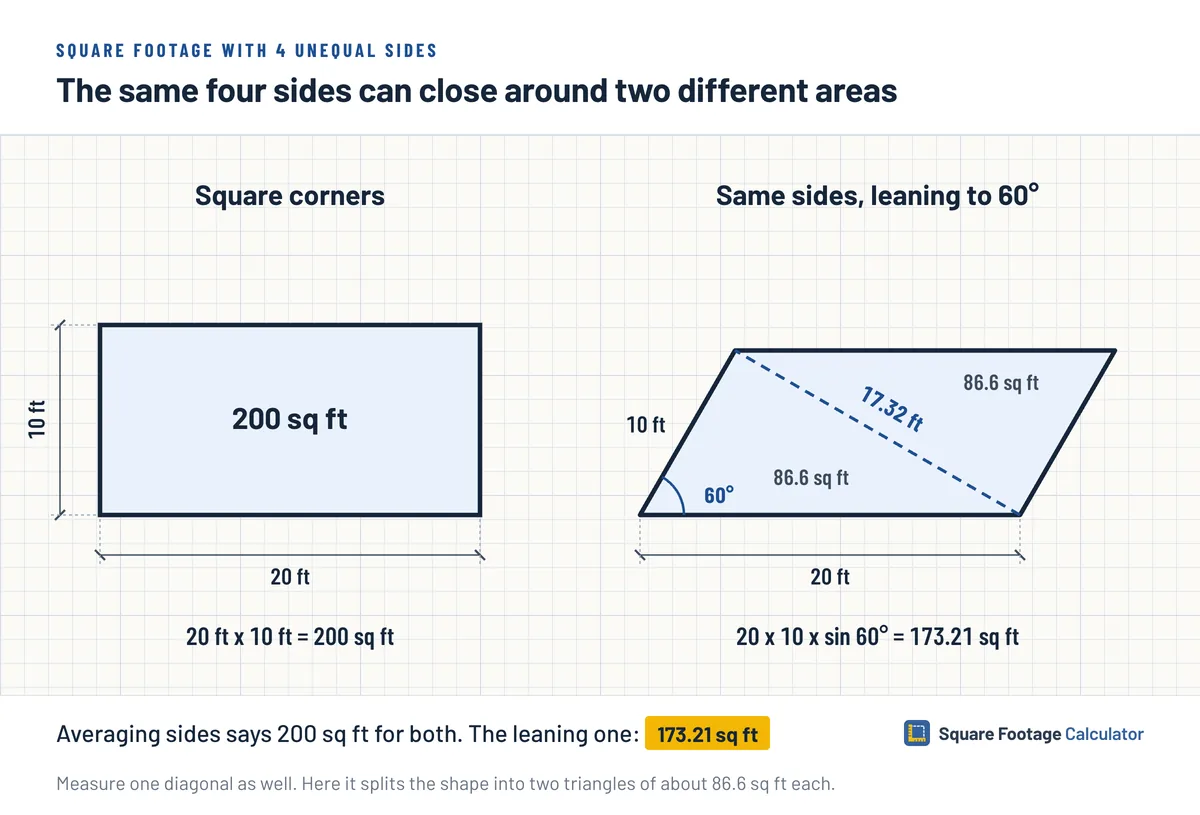
Measure one diagonal along with the four sides, then add the two triangles it makes. Averaging opposite sides and multiplying looks like length times width, but it is wrong for any shape that is not a rectangle.
A University of Washington paper on averaging opposite sides calls the method erroneous, though close when the shape is nearly rectangular. The paper shows it "will never underestimate the true area". It also shows that four sides alone cannot fix an area, so an exact answer needs at least one more measurement.
Picture a patch with 20 ft and 10 ft sides whose corners lean to 60 and 120 degrees. Averaging says 20 ft x 10 ft = 200 sq ft. The true area is 20 x 10 x sin 60°, about 173.21 sq ft, so the shortcut runs 15.5% high. The same four sides could also close into a true 200 sq ft rectangle.
Tape the diagonal that stays inside the shape, because on an arrow-shaped lot one of the two falls outside. Here the short diagonal is 17.32 ft, leaving two triangles with sides of 20, 10 and 17.32 ft. The three-sides rule for a triangle gives about 86.6 sq ft for each, so the patch is about 173.2 sq ft.
A deed that lists only four side lengths has the same gap, so a lot's recorded size has to come from a document that states the area.
Shoelace formula for corner coordinates
Any straight-sided outline can be worked from its corners alone. Give each corner an x and a y, list them in order around the edge, and cross-multiply each corner with the next one. Half the difference between the two sums is the area, which is the shoelace formula.
In a room, call one corner 0, 0. Measure x along one wall and y along the wall square to it. The table runs the same L room, with the last row wrapping back to corner A.
| Corner | x | y | x times next y | Next x times y |
|---|---|---|---|---|
| A | 0 ft | 0 ft | 0 sq ft | 0 sq ft |
| B | 20 ft | 0 ft | 160 sq ft | 0 sq ft |
| C | 20 ft | 8 ft | 160 sq ft | 96 sq ft |
| D | 12 ft | 8 ft | 168 sq ft | 96 sq ft |
| E | 12 ft | 14 ft | 168 sq ft | 0 sq ft |
| F | 0 ft | 14 ft | 0 sq ft | 0 sq ft |
| Sum | 656 sq ft | 192 sq ft |
So (656 minus 192) ÷ 2 = 232 sq ft, the same as splitting and subtracting. Go round clockwise and the result is minus 232, so drop the sign.
Swap C and D and the list traces a different outline with a slanted notch, which gives a wrong 224 sq ft. Corners that point inward cause no trouble as long as you list them in the order you meet them walking the edge.
A lot works the same way. Corners at (0,0), (120,0), (135,90), (60,140) and (0,100), all in feet, give 15,150 sq ft, about 0.35 acre once you apply the square feet to acres conversion. No site plan to read corners from? Tracing the lot on an online map gives a figure to check against.
Bay windows and clipped corners
Treat an angled bay as a trapezoid. Average its two parallel sides and multiply by the depth, measured square to the wall and never along a slanted side.
Say the bay is 9 ft across where it meets the room, 5 ft across the glass and 2 ft 6 in deep. That depth is 2.5 ft, so the bay holds (9 + 5) ÷ 2 x 2.5 = 17.5 sq ft. Add it to the main rectangle.
Each slanted side of this bay runs 3.2016 ft, since it steps 2 ft sideways over the 2.5 ft depth. Plug that in as the depth and you get 22.41 sq ft, which counts 4.91 sq ft of floor that is not there.
A corner sliced off on an angle is the whole rectangle minus a right triangle, and that triangle is half of its two short sides multiplied together.
Measuring a curved edge with offsets
Pull a straight baseline along the curve, then measure straight out from it to the curve at equal steps. Those distances are called offsets, and they turn the curve into thin strips you can add.
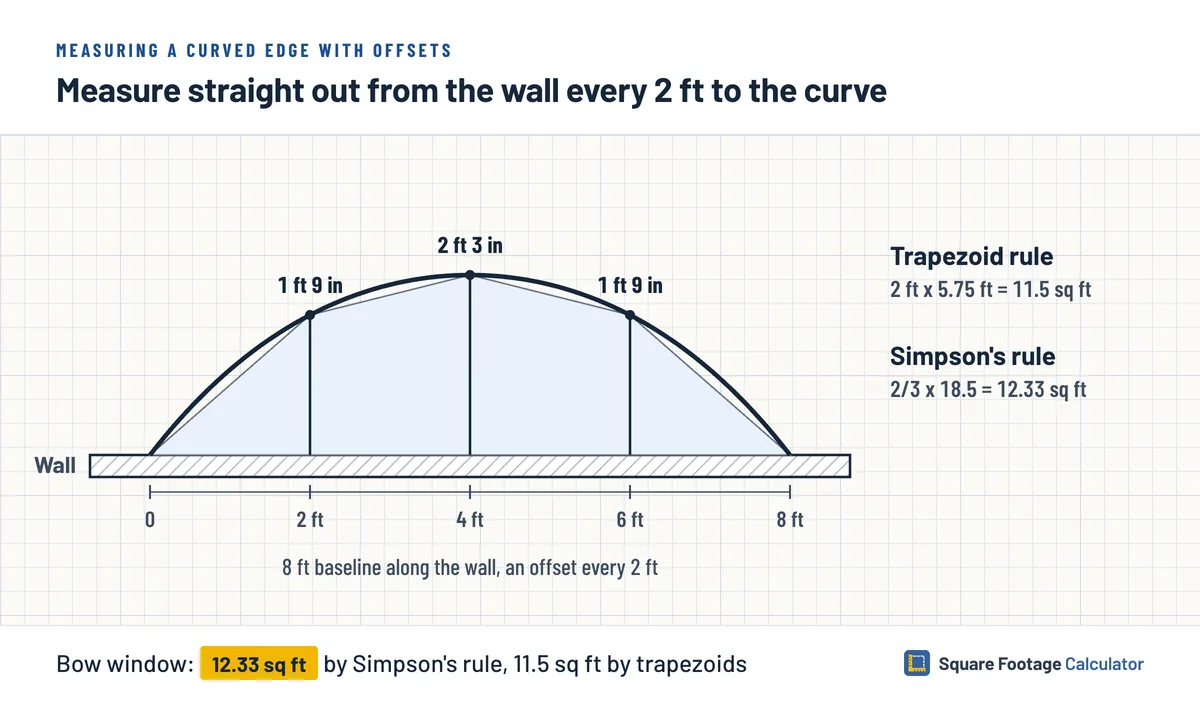
A bow window bulges out from 8 ft of wall. Every 2 ft along the wall, measure out to the glass: 0, 1 ft 9 in, 2 ft 3 in, 1 ft 9 in, 0. In feet that is 0, 1.75, 2.25, 1.75 and 0.
- Trapezoid rule. Each strip is the spacing times the average of its two offsets. In one pass, halve the two end offsets, add the middle ones, and multiply by the spacing: 2 ft x 5.75 ft = 11.5 sq ft.
- Simpson's rule. Weight the offsets 1, 4, 2, 4, 1, add them to get 18.5, and multiply by a third of the spacing: 2/3 x 18.5 = 12.33 sq ft. The Simpson's rule weights need an odd count of offsets, so take one more reading if you have an even count.
Straight lines between offsets cut inside an outward bulge, so the trapezoid figure reads a little low. Simpson's rule bends a curve through each three offsets and hugs the bow closer. Tighter spacing shrinks the gap either way.
Outdoors, to calculate the square footage of an irregular area such as a curved patio, pull a string tight along the edge as the baseline. A bay that is a true half circle needs no offsets at all, just half of the area of a circle.
Regular hexagons, octagons and pentagons
When every side and every angle match, the area is a fixed factor times the side squared. A second route works for any regular shape: half the perimeter times the apothem, the distance from the center to the middle of a side.
The table gives one worked size for each shape.
| Shape | Factor | Example side | Area |
|---|---|---|---|
| Regular pentagon | 1.7205 x side² | 6 ft | 61.94 sq ft |
| Regular hexagon | 2.5981 x side² | 7 ft | 127.31 sq ft |
| Regular octagon | 4.8284 x side² | 5 ft | 120.71 sq ft |
The hexagon checks out by the apothem route. Its perimeter is 42 ft and its apothem about 6.0622 ft, and half of 42 times 6.0622 is 127.31 sq ft.
Check the total a second way
Work every odd outline by two methods before you turn the room total into flooring cartons. Pair a room's split with its subtraction, and a lot's corner points with triangles along a diagonal. If the totals disagree, measure again.
FAQ
How is a weird shape measured in square feet?
Look at the edges first, because they decide how you work out the square footage of irregular shape rooms. Straight edges can be cut into rectangles and triangles or plotted as corner points, while a curve needs offsets from a baseline.
How many square feet is an L-shaped room?
Cut it at the inside corner into two rectangles and add them, or subtract the missing block from the rectangle that wraps the room. A 20 ft by 14 ft L with an 8 ft by 6 ft notch covers 232 sq ft, not the 280 sq ft that length times width gives.
How do I measure land with uneven sides?
Add one diagonal to your side measurements, then work out the two triangles it makes. With five or more corners, plot an x and y for each one instead. The square footage of irregular shape lots cannot come from side lengths alone, since the same four sides can enclose different areas.
What is the area formula for a rhombus?
Multiply the two diagonals and halve the result. Side times side overstates the area, because the corners of a rhombus slant unless it is a square. Diagonals of 10 ft and 7 ft give 35 sq ft, and base times height reaches the same area if you have those measurements instead.
How do you find an irregular hexagon's area?
Plot its six corners as x and y readings and use the shoelace formula, because the 2.5981 x side squared factor holds only when every side and angle match. A hexagon deck with no corner pointing inward can also be split into four triangles drawn from one corner, and those four areas added together.
Can graph paper estimate an odd shape?
Yes, for a rough first guess. Draw the outline at one square per square foot, count the squares and judge the partial ones by eye. That is good enough to catch a big slip in your tape work, but it is not a figure to buy material from.
Conclusion
Keep the lettered sketch with your final number, because a total that looks wrong later can only be traced back through its pieces. The same letters double as a wall list, ready for when you add up wall area one wall at a time.