To go from linear feet to square feet, multiply the run by its width, both in feet, so 10 linear feet of a 6 inch strip covers 5 square feet. Get that width from a tape measure rather than the tag. Lumber runs narrower than its name, and a 1 x 6 board is 5 1/2 inches across.
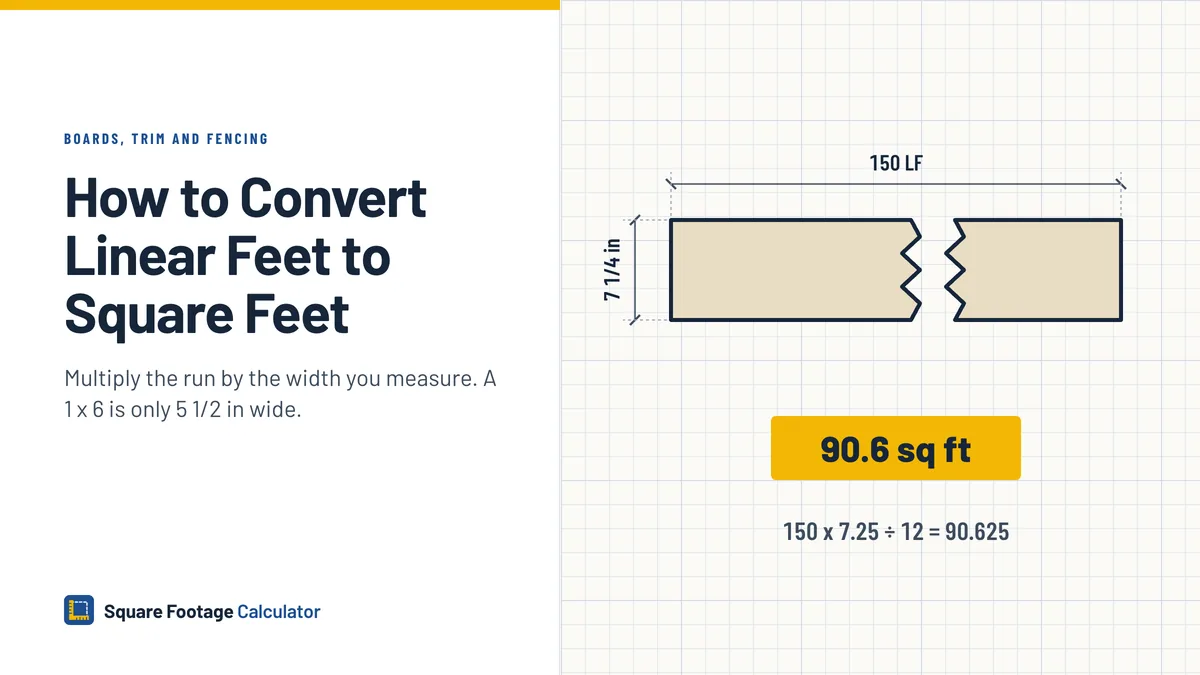
Table of Contents
Linear Feet to Square Feet Formula
Square feet = linear feet x width in feet. If you measured the width in inches, multiply the linear feet by those inches and then divide the product by 12.
You have 150 linear feet (LF) of 1 x 8 boards, and the tape reads 7 1/4 in across the face.
- 150 x 7.25 = 1,087.5.
- 1,087.5 ÷ 12 = 90.625, so the boards cover about 90.6 sq ft.
Had you trusted the label's 8 in, you would expect 100 sq ft and come up nearly 10 sq ft short on the job. Every board count starts from the area it must cover, which the square footage calculator gives from length and width. An L-shaped or angled floor needs one more step: split the irregular shape into rectangles and add them.
Is Square Feet the Same as Linear Feet
No. A linear foot is a length of 12 inches, measured along one edge. A square foot is a patch of surface 12 in on each side. The two match only for material exactly 12 in wide, where every foot of length also covers one square foot.
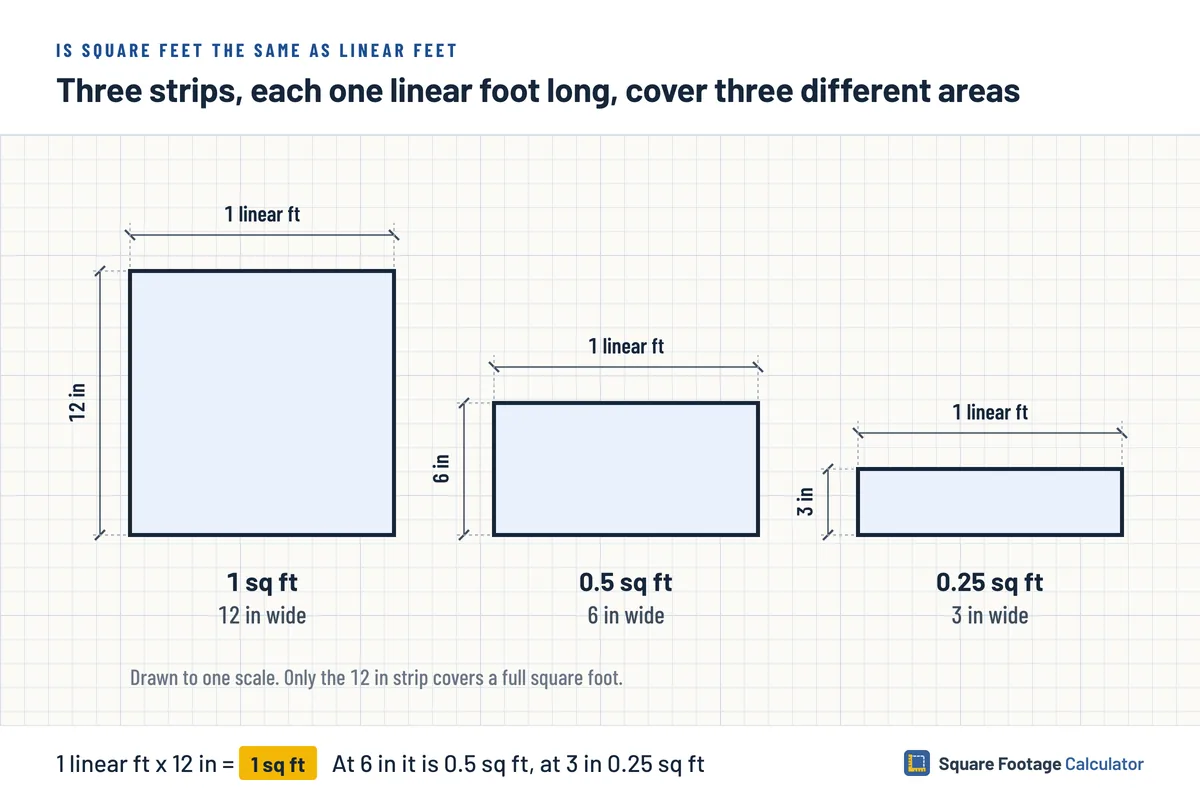
You will see the length unit written several ways. PS 20, the American Softwood Lumber Standard that NIST (National Institute of Standards and Technology) publishes, abbreviates it LFT or Lin Ft. NIST Handbook 130, a model regulation that states can adopt, says "lineal footage", and a running foot is the same 12 inches.
What is linear square footage
Linear square footage is not a real unit. People who say it mean either how much surface a run of trim covers, or how many feet of material an area will eat up. Both questions need a width, so 40 square feet equals 40 linear feet only for stock that is 1 ft wide.
Nominal vs Actual Board Widths
Buy by the width you measure, not the size printed on the tag. The trade name is the nominal size. PS 20 says it is larger than the dressed size, the size after a machine surfaces the board, and must not be read as one. A dry 2 x 4, for example, is 1 1/2 by 3 1/2 in.
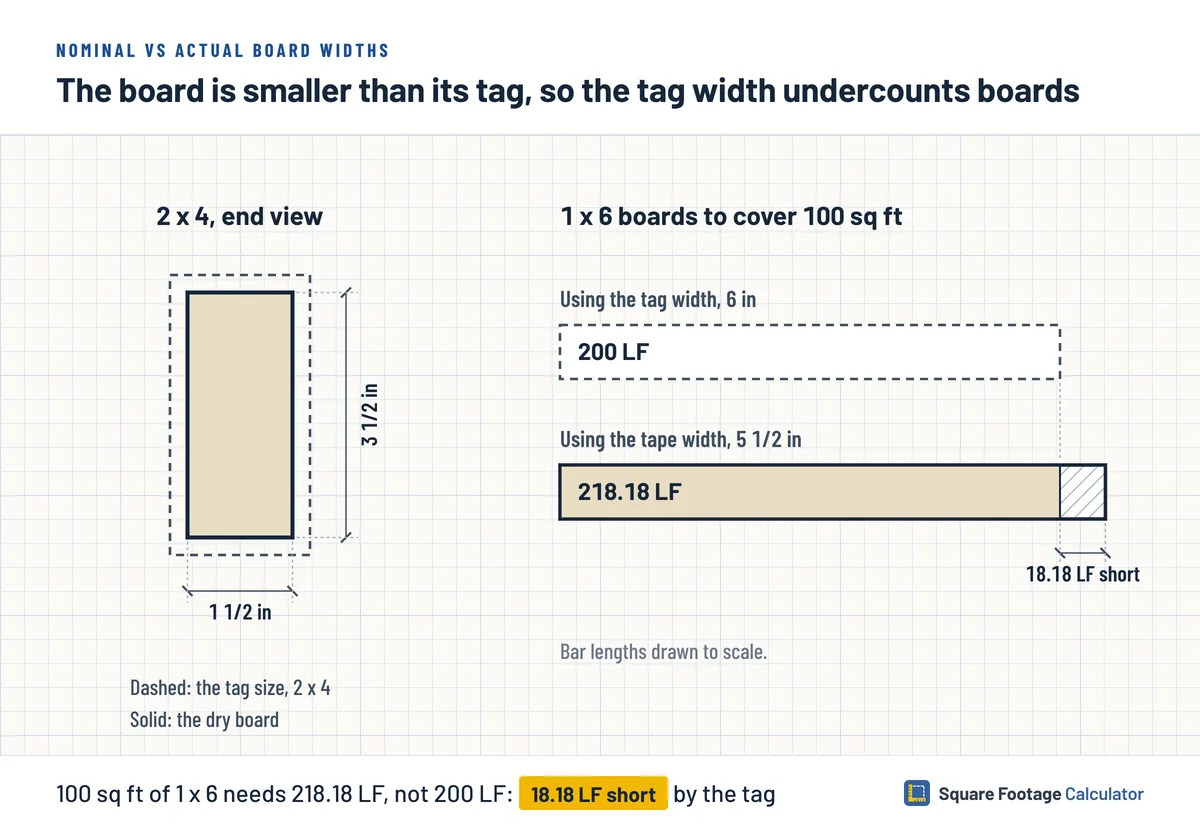
Watch what that gap does to a 100 sq ft job.
| Board | Real dry width | LF if you use the tag width | LF you really need | Shortfall |
|---|---|---|---|---|
| 1 x 4 or 2 x 4 | 3 1/2 in | 300 LF | 342.86 LF | 42.86 LF |
| 1 x 6 or 2 x 6 | 5 1/2 in | 200 LF | 218.18 LF | 18.18 LF |
| 1 x 8 or 2 x 8 | 7 1/4 in | 150 LF | 165.52 LF | 15.52 LF |
| 1 x 10 or 2 x 10 | 9 1/4 in | 120 LF | 129.73 LF | 9.73 LF |
| 1 x 12 or 2 x 12 | 11 1/4 in | 100 LF | 106.67 LF | 6.67 LF |
Narrow boards hurt most. Ordering 1 x 4 boards at their label width leaves you over 40 feet short per 100 sq ft.
"Dry" means 19% moisture or less. Wetter wood is a little wider. Handbook 130 puts the change at roughly 1% in size for every 4% in moisture.
Linear Feet to Square Feet Conversion Chart
Read across from your measured width. The middle column is the area one foot of length covers; the right column is how much length 100 sq ft calls for.
| Width | Sq ft per linear ft | Linear ft per 100 sq ft |
|---|---|---|
| 1 in | 0.0833 | 1,200 LF |
| 2 in | 0.1667 | 600 LF |
| 3 in | 0.25 | 400 LF |
| 4 in | 0.3333 | 300 LF |
| 6 in | 0.5 | 200 LF |
| 8 in | 0.6667 | 150 LF |
| 12 in (1 ft) | 1 | 100 LF |
| 2 ft | 2 | 50 LF |
| 4 ft | 4 | 25 LF |
| 12 ft | 12 | 8.33 LF |
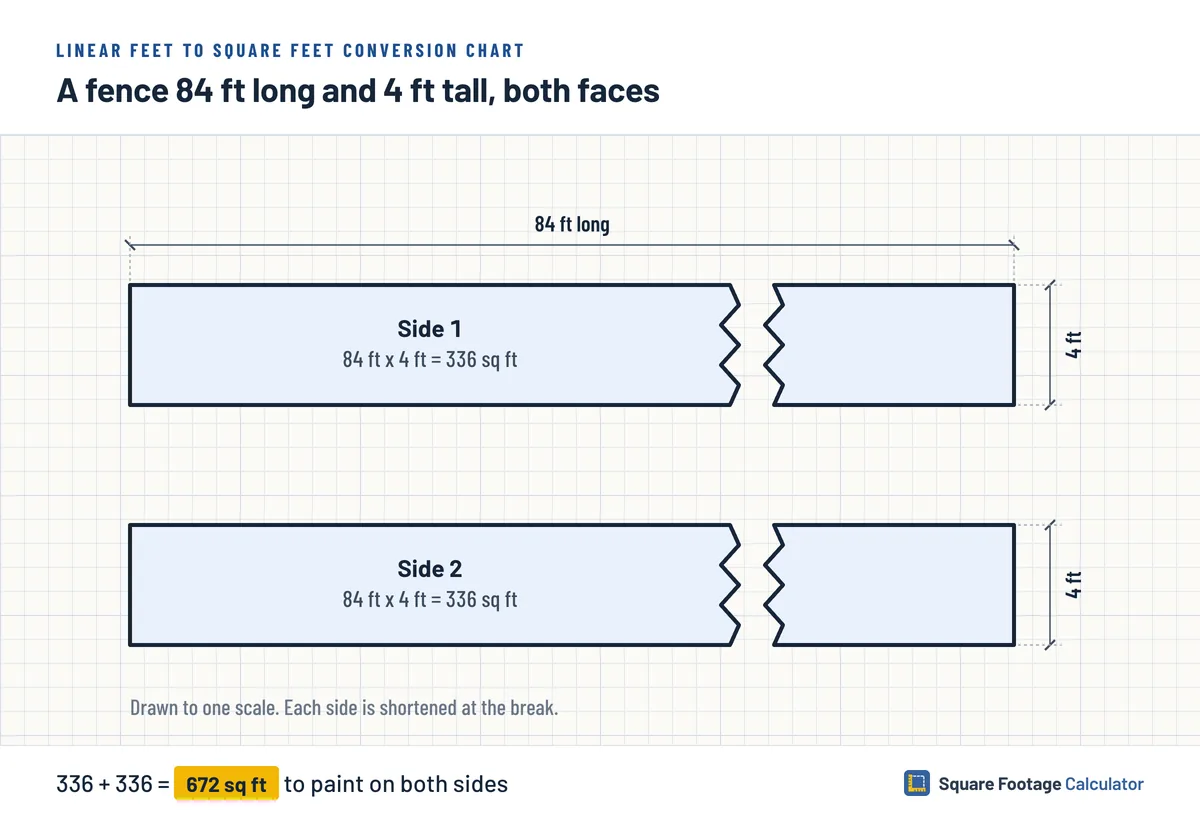
The rows past 1 ft suit fences and wall faces, where the height plays the role of width. A fence 84 ft long and 4 ft tall has 84 x 4 = 336 sq ft on each side. A fence painted on both sides doubles that to 672 sq ft, the figure to take into a paint coverage check.
Going From Square Feet Back to Linear Feet
Divide the area by the width in feet. With the width in inches, multiply the area by 12 first and then divide by the inches.
Say a wall section is 120 sq ft and you plan to run plain square-edge 1 x 6 boards, which measure 5 1/2 in.
- 120 x 12 = 1,440.
- 1,440 ÷ 5.5 = 261.82.
- Buy 262 LF, plus whatever spare your cuts will need.
The label width would have said 240 LF, about 22 ft too little. That 120 is the wall's width times its height, less any doors and windows, and the square footage of the wall shows how to measure it. For linear yards, divide the linear feet by 3; square yards are a different unit with their own math.
Square Feet to Board Feet
Multiply the face area in square feet by the thickness in inches to get board feet. A board foot is a volume. Handbook 130 defines it as 144 cubic inches of wood, the same as a board 1 ft long, 1 ft wide and 1 in thick.
To count board feet, PS 20 multiplies three label figures: thickness in inches, width in feet and length in feet. A 2 x 8 that is 12 ft long has a face of 8 ÷ 12 x 12 = 8 sq ft, and 8 x 2 = 16 board feet.
This is the one place to keep the label sizes. Board feet are built on nominal dimensions, so PS 20 warns the unit is not a precise volume. If you see MBM, it means a thousand board feet, the abbreviation PS 20 uses.
Linear Feet vs Square Feet on Labels
Softwood lumber labels count length rather than area, even when the boards end up covering a wall or deck.
Under Handbook 130, softwood lumber is sold by piece count plus either each piece's length or the total lineal footage. A seller who uses a nominal size must mark it "nominal" or "nom" and display the actual sizes on a table or label. Read those sizes first, then confirm the width with your tape.
Packaged rolls of 4 sq ft or more must show the area first, then length and width, unless the roll is 4 in wide or less. The handbook's sample label reads 25 ft2 (12 in x 8.33 yd). Check it yourself: 8.33 yd is 24.99 ft, and at 1 ft wide that is about 25 sq ft. Carpet cut from a store roll is billed by the exact size shipped instead, and flooring square footage walks through that cut.
Hardwood surface measure
Handbook 130 also lets hardwood dealers sell by surface measure, a square foot count rounded to a whole number. Width in inches times length in feet, divided by 12, gives the figure; a half or less rounds down. Length first drops to a standard length, from 4 to 16 ft in whole feet.
So a board 5 3/4 in wide and 10 ft 7 in long counts as 10 ft long. 5.75 x 10 ÷ 12 = 4.79, which is billed as 5 sq ft. The rule covers hardwood lumber only, not flooring or molding.
Linear Feet Conversion Mistakes
Each slip below starts with the width: the wrong unit, the tag's number, or no width at all.
| Slip | Example | What you get | Correct figure |
|---|---|---|---|
| Inches treated as feet | 150 LF x 7.25 | 1,087.5 "sq ft" | 90.625 sq ft |
| Tag width instead of tape width | 150 LF of 1 x 8 at 8 in | 100 sq ft | 90.625 sq ft |
| Square root of the area | √120 | 10.95 LF, one side of a square | 261.82 LF at 5 1/2 in |
| Area over inches, no x 12 | 120 ÷ 5.5 | 21.82 LF | 261.82 LF |
| Linear feet read as square feet | 150 LF of 1 x 8 | 150 sq ft | 90.625 sq ft |
A sense check catches most of these. Stock narrower than 12 in always gives fewer square feet than linear feet. Stock wider than 12 in gives more.
FAQ
What is 25 linear feet in square feet?
Twenty-five linear feet has no fixed area until you know the width. Twenty-five feet of 1 x 10, which really measures 9 1/4 in, covers 25 x 9.25 ÷ 12 = 19.27 sq ft. The same length of 12 in stock covers exactly 25 sq ft.
How many linear feet is 59 square feet?
Fifty-nine square feet equals 59 linear feet only at 12 in wide. With boards 5 1/2 in wide it is 59 x 12 ÷ 5.5 = 128.73 linear feet, so buy 129.
What are running feet?
Running feet are plain linear feet: each one is 12 in of length, with no width counted. If a quote shortens the unit, ask the seller what the abbreviation means and what width it assumes.
Is a linear foot just a foot?
Yes. The word "linear" only tells you the foot runs along a line, so it is 12 in long, or exactly 0.3048 m. NIST Handbook 130 uses the variant "lineal" for softwood lumber counted by length.
Conclusion
Before you pay for boards, hold a tape across one and write that width on the order. On the 120 sq ft board wall, that one number moved the count from 240 LF to 262 LF. A fence is the same sum with height standing in for width, and its run comes from taping the sides of your yard.