How to find square footage of a property comes down to the lot's length times its width in feet, unless your plat, survey or parcel record already lists it. The example lot below holds 9,700 sq ft of land and, once the buildings, paving and beds come out, about 6,600 sq ft of grass.
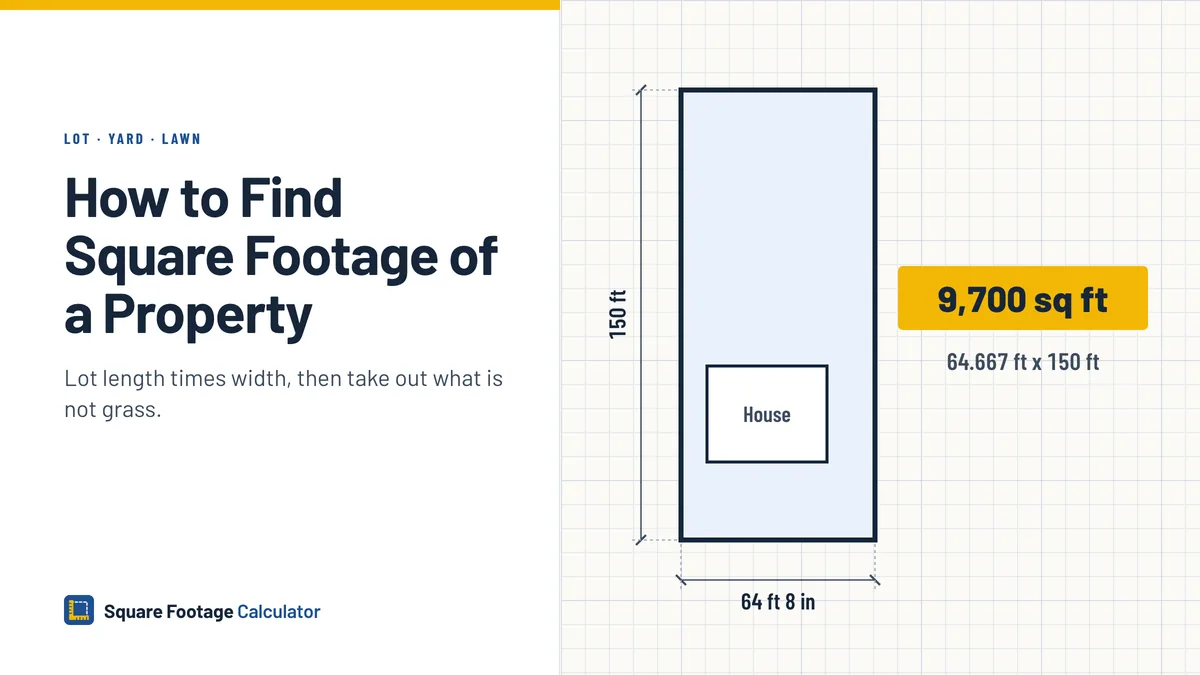
Table of Contents
How to find square footage of a property
Multiply length by width, both in feet. For a lot with four square corners, that one step is the whole square feet formula for land.
The example lot has a 64 ft 8 in street frontage and runs 150 ft back. Eight inches is 0.667 ft, so the front is 64.667 ft, and 64.667 x 150 = 9,700 sq ft.
To measure square feet of land yourself, hold the tape on the lot lines themselves. A fence or hedge can stand off the true line, and following it will skew the number. An L-shaped or flag lot is really two or three rectangles; measure each one and let the square footage calculator total them.
Where your lot size is recorded
Before you unroll a tape, look at the recorded plat or your survey. Both come from someone who measured the lines on the ground.
The county parcel viewer is easier to reach. Find your parcel on the assessor's site or the county geographic information system (GIS) map, then look for a lot area.
In the Bureau of Land Management (BLM) land description glossary, a plat is the drawing of a survey. It shows how long each line runs, which way it points, and the area of each parcel. The same glossary uses "lot" for one parcel in a recorded subdivision.
Counties are blunt about their online maps. Chautauqua County, New York warns that its GIS maps are not land surveys and should not decide boundary lines. Burleigh County, North Dakota, labels its parcel viewer as a picture for reference, not a survey.
The table shows what each record holds and whether a survey stands behind its lot area.
| Record | Where to get it | What it holds | Backed by a survey? |
|---|---|---|---|
| Recorded plat | County recorder | Line lengths and directions, parcel areas | Yes |
| Survey | Closing papers or a licensed land surveyor | Measured lines and corners | Yes |
| Parcel viewer | Assessor or county GIS site | Lot area if listed, outline, deed references | No, by the counties' own notes |
So treat an online lot area as a first guess. When your tape, the survey and the county map give three different answers, a licensed land surveyor is the person who finds where the lines really run.
Sq ft vs sq ft lot on a listing
On a listing, the sq ft number is the house and the sq ft lot number is the land it sits on. A listing that reads 1,280 sq ft | 9,700 sq ft lot describes a 40 ft x 32 ft one-story house on our example lot.
The lot figure covers the whole parcel, so the ground under the house, garage and driveway is part of it. The house figure is floor area, which comes from measuring the house itself.
Some listings give the lot in acres instead. Converting square feet to acres means dividing by 43,560, so this lot is about 0.22 acre.
How to measure a yard's square footage
Break the yard into rectangles, plus a triangle wherever a corner cuts at an angle. Find the area of every piece and add them.
A 100 ft tape goes fastest with a helper holding the far end. Working alone, push a measuring wheel in straight lines from corner to corner.
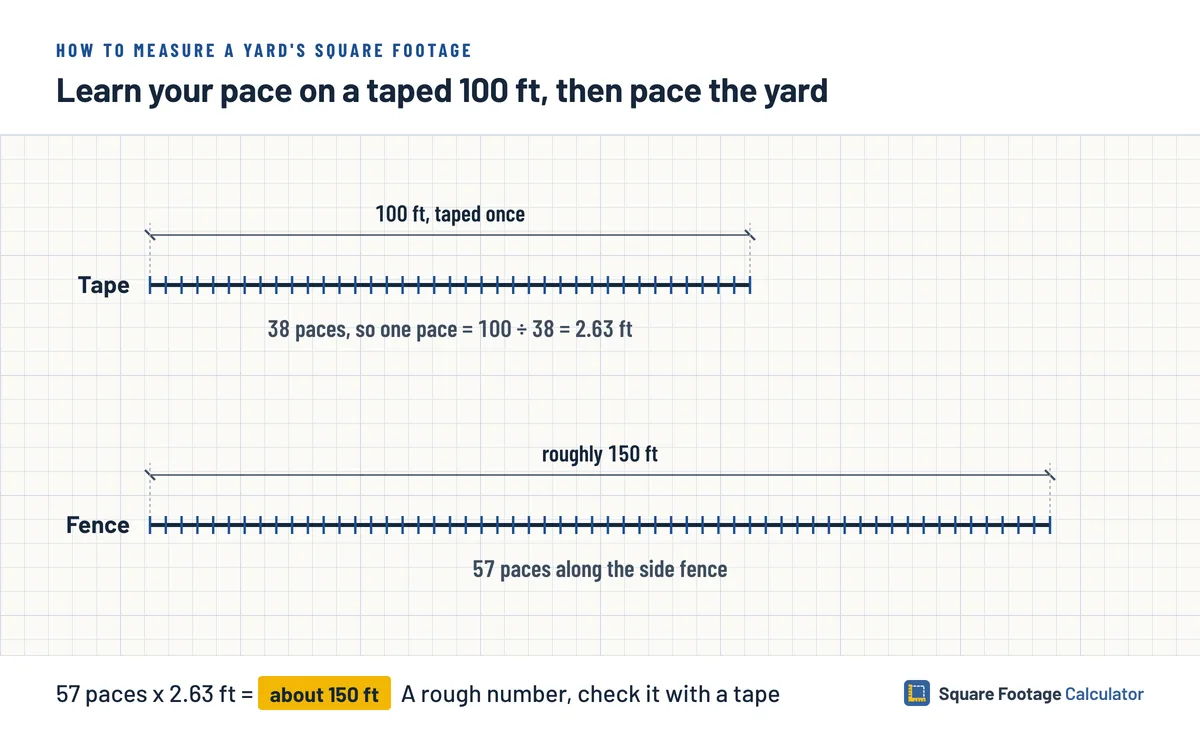
Only need a rough number? Pace it, but learn your stride first. Tape out 100 ft once and walk it at a normal gait. If that takes 38 paces, each pace is 2.63 ft, and 57 paces along the side fence comes to roughly 150 ft.
For an angled corner, the triangle formula multiplies base by height and halves the result. A strip you cannot walk, such as one behind a neighbor's fence, can be traced on a satellite map, though on a bank that gives only the flat area.
Our curved bed runs 36 ft along the back fence, and widths every 6 ft from that baseline give 225 sq ft by the offsets method for curved edges. A bed that is a full circle is quicker, since a circle's area is pi times the radius squared.
How to measure square footage of lawn
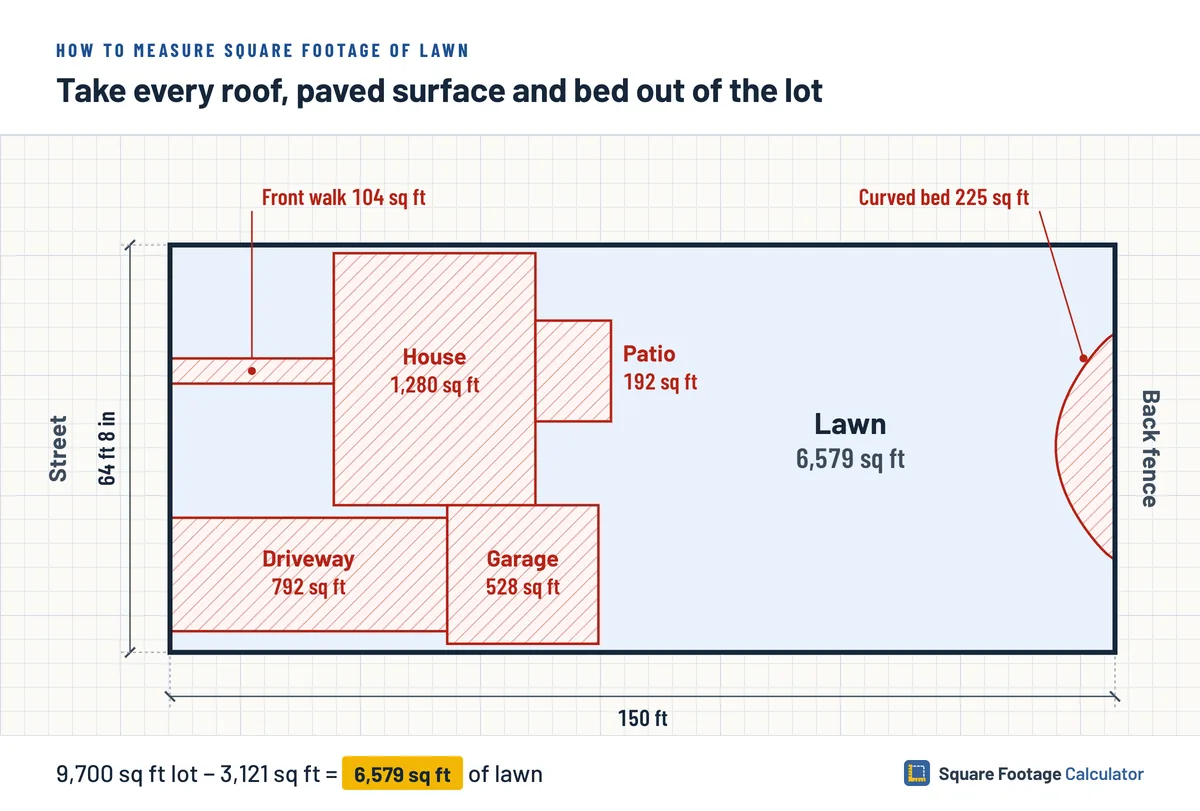
Take the lot and subtract everything that is not grass: house, garage, driveway, walks, patio and planting beds, each measured at its outer edge. Skip this step and you shop by the lot, the only land figure a listing gives you. The table runs that subtraction on the example lot.
| Part | Size | Square feet |
|---|---|---|
| Lot | 64 ft 8 in x 150 ft | 9,700 sq ft |
| House | 40 ft x 32 ft | minus 1,280 sq ft |
| Garage | 22 ft x 24 ft | minus 528 sq ft |
| Driveway | 18 ft x 44 ft | minus 792 sq ft |
| Patio | 12 ft x 16 ft | minus 192 sq ft |
| Front walk | 4 ft x 26 ft | minus 104 sq ft |
| Curved bed | 36 ft along the fence | minus 225 sq ft |
| Lawn | Lot minus 3,121 sq ft | 6,579 sq ft |
Paving, roofs and beds take up close to a third of this lot. Shopping by the 9,700 sq ft lot figure would mean buying for 47% more grass than is there.
Square feet formula for land on a slope
On a real bank, the grass covers more ground than the flat area a map or a level tape shows. Multiply that flat area, called plan area, by √(1 + slope²), where slope is rise divided by run.
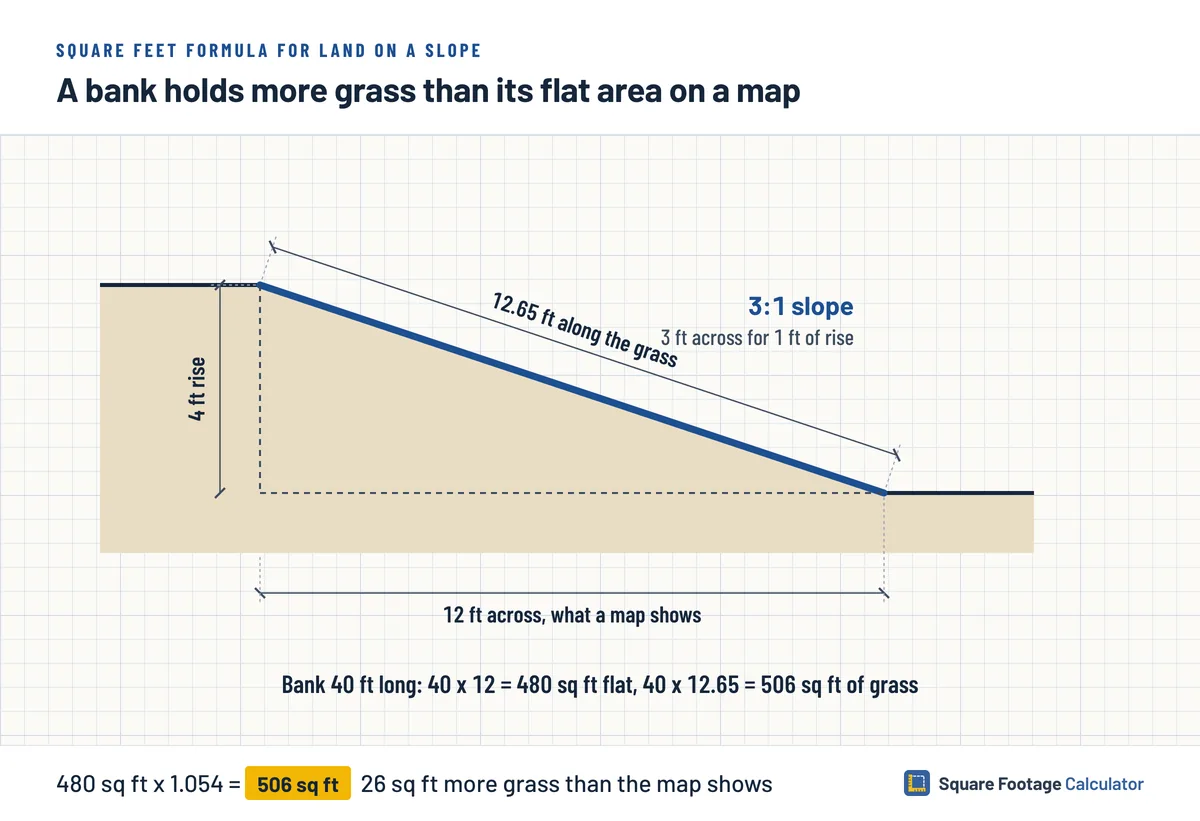
Ratios below read across to up: 3:1 means 3 ft across for every 1 ft of rise.
| Slope | Rise per 100 ft across | Extra surface over flat area |
|---|---|---|
| 10% | 10 ft | +0.5% |
| 20% | 20 ft | +2.0% |
| 4:1 | 25 ft | +3.1% |
| 3:1 | 33.3 ft | +5.4% |
| 2:1 | 50 ft | +11.8% |
| 1:1 | 100 ft | +41.4% |
The back of our lot is a bank 40 ft long that drops 4 ft over 12 ft across, a 3:1 slope. Its plan area is 480 sq ft. Its surface is 480 x 1.054 = 506 sq ft.
You can confirm it on site by laying the tape down the face of the bank: √(12² + 4²) = 12.65 ft, and 12.65 x 40 = 506 sq ft. Those extra 26 sq ft bring the lawn to 6,605 sq ft. Under about a 10% grade the gain stays below 1%, which is why gentle yards can ignore it.
How many bags for your lawn's square footage
Divide the lawn area by the coverage printed on the bag, then round up. Coverage varies from product to product, so go by the label in your hand.
As one example, Scotts says a 15 lb bag of its Turf Builder starter fertilizer for new grass will treat 5,000 sq ft. It is plant food, not seed. Our 6,605 sq ft lawn works out to 1.32 bags, so buy 2; a single bag would leave about 1,605 sq ft unfed.
Some labels give a rate per 1,000 sq ft instead. Iowa State University Extension and Outreach scales that rate by multiplying it by the lawn area divided by 1,000. The Scotts bag works out to 3 lb per 1,000 sq ft, so this lawn takes 3 x 6,605 ÷ 1,000 = 19.8 lb. Going by the whole lot would call for 29.1 lb. For a turf quote in square yards, converting square feet to square yards takes this lawn to about 734 sq yd.
FAQ
What is the square feet of a plot?
A plot's square footage is its length times its width in feet, or the sum of its pieces when the shape is not a rectangle. A plot 64 ft 8 in wide and 150 ft deep holds 9,700 sq ft. Check your plat or survey first, since either may already list it.
Does lot size include the house?
Yes. The lot number runs from boundary to boundary, with every building standing inside it, so never add the house figure on top. To see your open ground, subtract the footprints. A 9,700 sq ft lot with a 1,280 sq ft house and a 528 sq ft garage leaves 7,892 sq ft.
Can I find my lot size online?
Try your county first. Pull up your parcel on your county assessor's site or GIS parcel viewer and look for a lot area in the record. Use any figure as a first guess only, because counties such as Burleigh in North Dakota say their viewer data does not represent a survey.
Why does my survey differ from the county map?
A survey and a county map were made for different jobs. A survey comes from someone measuring lines and corners on the ground, while a county parcel map is a reference drawing. Chautauqua County, New York, says its maps should not set boundary lines, so ask a licensed land surveyor where yours run.
How do you estimate square footage of a yard?
Pace it. Count your steps over a taped 100 ft, then divide 100 by that count to get your pace length. Walk the yard's length and width, turn the paces into feet, and multiply. At 38 paces per 100 ft, one pace is 2.63 ft.
How many square feet is my lawn?
Take your lot area and subtract every roof, paved surface and planting bed. What stays is lawn. A 9,700 sq ft lot with 3,121 sq ft of those falls to 6,579 sq ft. A 40 ft long bank then adds 26 sq ft of surface, for a final 6,605 sq ft.
Conclusion
Write both numbers down before you shop: the lot area from your plat or survey, and the lawn area left once the footprints come out. Keep the listing's house figure apart from both, because whether it counts a basement changes the floor area and never the lot. Feed labels want the lawn, which is why our example buys for 6,605 sq ft and not 9,700. Beds need their own number, since mulch or topsoil takes a depth as well, and the square feet to cubic yards conversion turns the two into an order.